<?xml version="1.0" encoding="utf-8"?><feed xmlns="http://www.w3.org/2005/Atom" xml:lang="en"><generator uri="https://jekyllrb.com/" version="3.10.0">Jekyll</generator><link href="https://haseebq.com/feed.xml" rel="self" type="application/atom+xml" /><link href="https://haseebq.com/" rel="alternate" type="text/html" hreflang="en" /><updated>2026-09-08T03:12:04+00:00</updated><id>https://haseebq.com/feed.xml</id><title type="html">haseeb qureshi</title><subtitle>Haseeb Qureshi is Managing Partner at Dragonfly, a crypto venture fund, and co-host of The Chopping Block. Essays on crypto, investing, and decision-making.</subtitle><author><name>Haseeb Qureshi</name></author><entry><title type="html">Silicon Valley doesn’t punish failure</title><link href="https://haseebq.com/silicon-valley-doesnt-punish-failure/" rel="alternate" type="text/html" title="Silicon Valley doesn’t punish failure" /><published>2026-06-27T00:00:00+00:00</published><updated>2026-06-27T00:00:00+00:00</updated><id>https://haseebq.com/silicon-valley-doesnt-punish-failure</id><content type="html" xml:base="https://haseebq.com/silicon-valley-doesnt-punish-failure/"><![CDATA[<blockquote>
  <p>A founder just informed me that they ran out of runway and have to wind down their business.</p>

  <p>Paying himself $212k a year, in a bear market, with a pre revenue startup.</p>

  <p>And somehow it’s “the market’s fault.”</p>

  <p>Can’t make this shit up.</p>

  <p>— <a href="https://x.com/sjdedic/status/2070162927735202175">Simon Dedic (@sjdedic) on X</a></p>
</blockquote>

<p>People often ask what makes Silicon Valley culture so special and hard to replicate.</p>

<p>It’s not the talent or the capital. There are many places with both.</p>

<p>The secret sauce of Silicon Valley is that it doesn’t punish failure. This is rare to the point of being basically unique.</p>

<p>Failure is already its own punishment. Spending years of your life trying to build something that goes nowhere is a deep and unforgiving grief. The time, the energy, the money, the opportunity cost, it’s impossible to erase that.</p>

<p>But what SV startup culture strips away is that second layer of punishment: the shame that society stacks on top. The whispers at the next party, that you’ve embarrassed yourself, that you should have known better. In SV, there’s no shame in winding down a startup, it’s the mark of having entered the arena and taken a swing.</p>

<p>But then there’s stuff like this. This is how it works almost everywhere else in the world. This founder failed, therefore the salary he paid himself is a disgrace (if he did OK, no one would ever bring it up).</p>

<p>Silicon Valley VCs would never post anything like this about a wound down startup. No mention of the founder’s background either: Was $200K a paycut for them? Do they live in NYC/SF where $200K is ~$100K take-home? Do they have kids, a mortgage? And come on, no seed-stage company is running out of money because the founder is paying themselves $200K~, seed rounds are in the millions. $200K/yr is like a single engineer’s salary. Yeah $200K is on the high side, but really? If you think this founder embezzled from the company, then sue them. If you thought $200K was unconscionable, did you mention that when you invested? Otherwise what is the point of this?</p>

<p>This is why in Silicon Valley (and China and Israel too), startup culture is a gem that’s almost impossible to replicate anywhere else in the world. People can’t help themselves to rub salt in the wounds of failure, and they don’t think about the wider culture reverberations of that attitude.</p>

<p><em>Originally published <a href="https://x.com/hosseeb/status/2070948036994351201">on X</a>, June 2026.</em></p>]]></content><author><name>Haseeb Qureshi</name></author><category term="tech careers" /><summary type="html"><![CDATA[A founder just informed me that they ran out of runway and have to wind down their business. Paying himself $212k a year, in a bear market, with a pre revenue startup. And somehow it’s “the market’s fault.” Can’t make this shit up. — Simon Dedic (@sjdedic) on X]]></summary><media:thumbnail xmlns:media="http://search.yahoo.com/mrss/" url="https://haseebq.com/precipice_snbyis.jpg" /><media:content medium="image" url="https://haseebq.com/precipice_snbyis.jpg" xmlns:media="http://search.yahoo.com/mrss/" /></entry><entry><title type="html">The Rise of the 149-Person Company</title><link href="https://haseebq.com/the-rise-of-the-149-person-company/" rel="alternate" type="text/html" title="The Rise of the 149-Person Company" /><published>2026-06-22T00:00:00+00:00</published><updated>2026-06-22T00:00:00+00:00</updated><id>https://haseebq.com/the-rise-of-the-149-person-company</id><content type="html" xml:base="https://haseebq.com/the-rise-of-the-149-person-company/"><![CDATA[<p>@SemiAnalysis_ recently found something bizarre in the economics of AI coding subscriptions. If you run them at max usage limits, you’re actually paying 20x-70x cheaper than you would buying tokens through the API.</p>

<p>Many people looked at this and said: oh my god, look how much the labs are subsidizing tokens, the bubble must be about to pop soon.</p>

<p>This is the wrong response. The reason why labs are willing to offer such generous plans, of course, is because most users are rarely hitting their usage limits. The product works like a gym membership: the limit is generous because most people barely use it.</p>

<p>But I’ve spent a lot of time thinking about this, and it’s true that something weird is going on here.</p>

<p>We don’t know what their actual blended margins are on subscriptions, but SemiAnalysis estimates that at 20% average utilization, Anthropic breaks even on their Max 5x plan. 20% utilization is probably on the high side, especially in orgs where everyone (including non-coders) have subscriptions and are only busting it out once in a while. Most places I know, including Dragonfly, give out Claude Code subscriptions liberally and encourage non-coders to experiment with it.</p>

<p>But what SemiAnalysis doesn’t dwell on here is that this is exclusively a small company phenomenon. The subscription pricing model is not available to large companies.</p>

<p>Here’s why: at 150+ people, you are forced off the subscription model, which is known as the “Team” plan. You have to switch to “Enterprise,” which is priced as $20/seat base, plus API pricing per token used. Enterprises must pay linearly based on token costs, and SemiAnalysis believes API tokens are priced at roughly 75% gross margins. This is a massive price hike that kicks in suddenly at 150 seats.</p>

<p><img src="/images/posts/the-rise-of-the-149-person-company/01.png" alt="Screenshot of Anthropic docs stating Team plans support up to 150 seats and larger orgs must upgrade to Enterprise" /></p>

<p>So if you’re a small business or a startup (or a personal user), you have a distorted view of AI spend. Your token pricing is actually very generous, and Anthropic may be running at low or even negative margin on you. You might have wondered why Microsoft and Uber are freaking out about token spend and talking about “token-minning.” This is why. They pay structurally higher costs per token than startups and individuals do.</p>

<p>But Anthropic doesn’t care! Max extracting from small companies or individuals just doesn’t matter much for a B2B company. If you look at companies like Datadog or Cloudflare, they make 80-90% of their revenue from large (100K+ ARR) contracts. Making 0 margins on the long tail is just a customer development cost.</p>

<p>This is the standard B2B sales way to think about this pricing strategy.</p>

<p>But there’s another way to think about this same situation: through the lens of tax policy.</p>

<p>Because if tokens are replacing labor, then the gross margin that OpenAI and Anthropic collect on tokens is effectively a tax on AI labor.</p>

<p>There are two major consequences to thinking about token pricing this way.</p>

<hr />

<h2 id="token-pricing-as-tax-policy">Token Pricing as Tax Policy</h2>

<p>Let’s assume the margins stated in the SemiAnalysis piece: breakeven on subscriptions, 75% gross margin on API for BigCos. The instinct is to call that a 75% tax on AI labor for large organizations, and 0% tax for startups. Standard tax analysis would say this is a disincentive to use AI labor within large companies, which pushes at the margin more toward less automation and retaining more human labor. (It obviously also incentivizes using smaller/open models, but the net effect is that it incentivizes both. Remember, we’re thinking at the margin here.)</p>

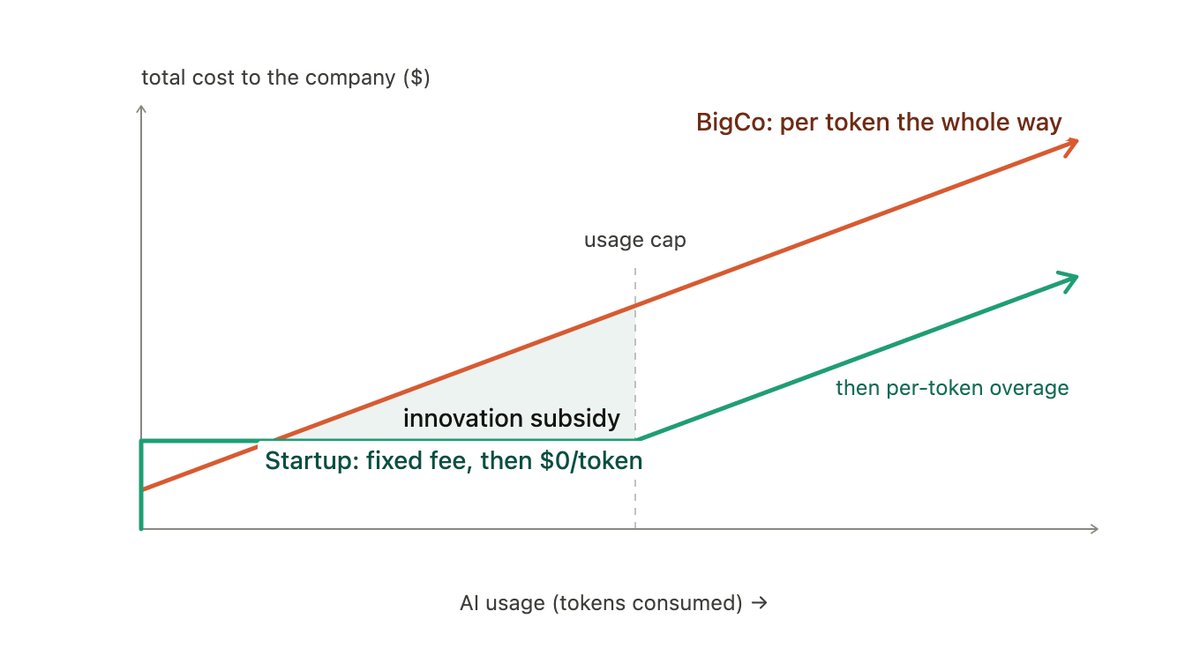
<p>But the part that drives behavior even more strongly is not the average rate. In tax policy it never is. What we care about is the marginal rate. And for startups on a flat-rate subscription, the marginal price of the next token, up until the usage limit, is zero. And a zero marginal price is the most distortionary a policy can possibly be.</p>

<p>For a startup, the subscription model is basically an innovation subsidy. The overwhelming incentive is to experiment how to spend the entire token budget as effectively as possible. That means running Ralph loops, papering your screen with Claude Code sessions, and orchestrating swarms of agents. Exploration is free until you hit the usage limit, so startups are effectively competing to squeeze every last drop out of their subscriptions to out-produce their competition. Perversely, the more you use, the lower your average token price is. Each startup wants to be the one that makes Anthropic lose the most money on their subscription.</p>

<p><img src="/images/posts/the-rise-of-the-149-person-company/02.jpg" alt="Chart of cost versus AI usage: BigCo pays per token while a startup's flat fee creates an &quot;innovation subsidy&quot; gap" /></p>

<p>BigCos face the opposite incentive. If you’re beyond the 150-seat threshold, every token of exploration is billed at full markup (with 75% surcharge!), so they’re punished linearly for exploring the frontier. BigCos will still automate the obvious high-volume tasks, but the marginal, experimental, risky automations never get found because the discovery cost is too high. This tax structure ultimately pushes them toward keeping more human labor and maintaining the same overall org structure.</p>

<p>It’s like a reverse Japan. Japan has a massive labor shortage due to its declining population. Historically this has meant Japan has pursued high degrees of automation, because high labor costs incentivize automation. That’s why Japan has robots in restaurants, factories, hotels, and hospitals. But weirdly, big companies find themselves in a reverse Japan situation: if they are paying very high taxes on AI usage, this creates LESS incentive to automate, and more incentive to retain the humans they already have (even more so if wages stagnate in the meantime).</p>

<p>So where does the labor displacement go in this model?</p>

<p>Everyone is watching the big companies for waves of AI layoffs. But at 75% rates, replacing your own workforce too aggressively with AI might just be uneconomic. The token budgets just explode.</p>

<p>But that doesn’t mean the displacement never happens. It just means the displacement shows up in a different shape.</p>

<p>When BigCos lose market share to AI-native startups that carry a fraction of the all-in labor costs, that will trigger layoffs as BigCo revenues and stock prices decline. But those jobs that are eliminated are never replicated at the startups who win the day. The net disemployment effect is the same, the air pocket just moves to a different line item within the economy (where the AI tax rate is lower).</p>

<p>This is also why “AI-washing” might not be a temporary phenomenon. AI-washing is when a company attributes layoffs to newfound AI efficiencies, when it’s actually just an excuse for ordinary business weakness. Many assume that this is a fad of the current AI hype cycle. But while everyone is primed to watch for big companies doing true AI layoffs “replacing jobs” with AI, it may never actually happen at scale. The labor displacement may happen instead through startups outcompeting the BigCos, the BigCos AI-washing all the way to their graves, and the startups never re-creating the old jobs. The job displacement will still happen, just not where everyone is looking.</p>

<p>So that’s the first consequence of this model. But there’s also a second, weirder consequence.</p>

<hr />

<h2 id="the-notch">The Notch</h2>

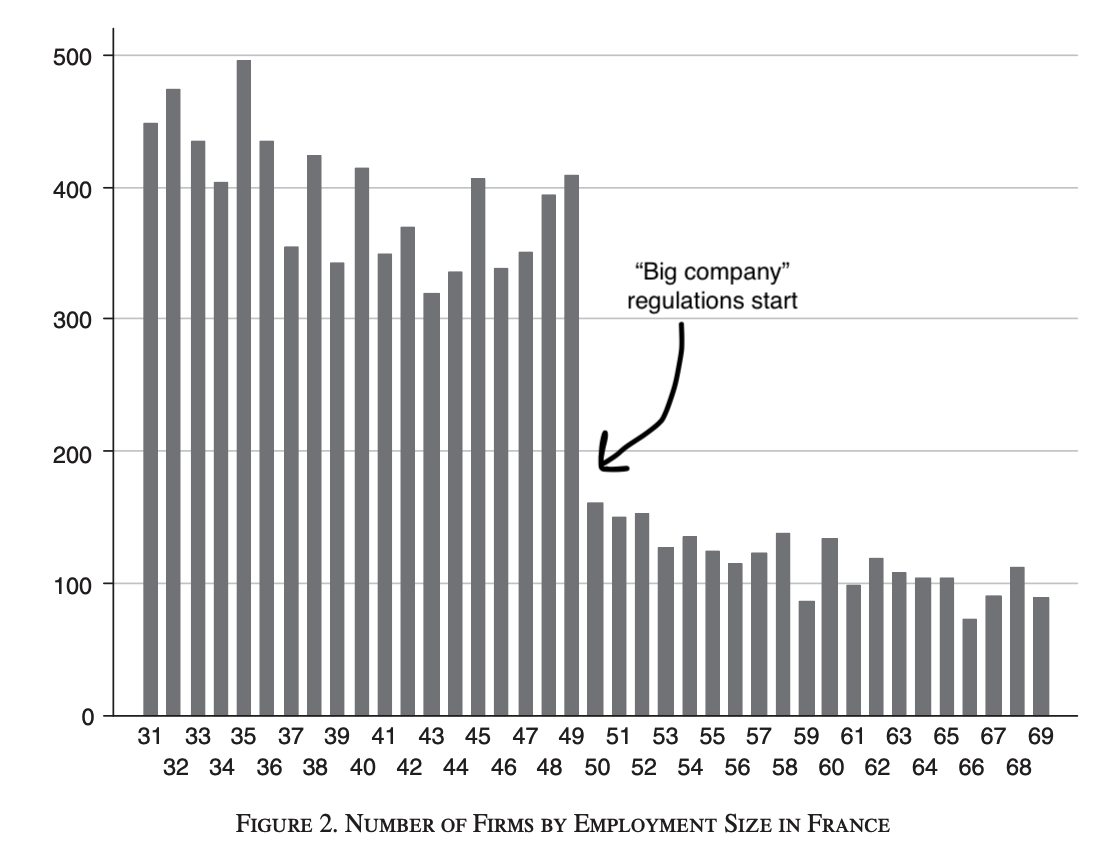
<p>A regulatory notch is a regulatory threshold that incentivizes a large discontinuity in behavior. Example: 30 hours a week for full-time employment incentivizes a lot of jobs that are exactly 29 hours/week. Famously, France has extremely demanding labor regulations that kick in at 50 employees (work councils, mandatory profit-sharing, firing protections), which are exempted for small companies. This results in massive incentives for employers to stay below the 50-person notch.</p>

<p><img src="/images/posts/the-rise-of-the-149-person-company/03.png" alt="Histogram of French firms by employee count, dropping sharply at 50 employees where big-company regulations begin" /></p>

<p>Extend this analogy to AI. The big labs have created a tax notch that punishes companies for going above the 150 seat threshold. This means you must stay small to keep your beautifully subsidized subscription pricing, and be taxed ~0% (or negative) on your tokens rather than 75%.</p>

<p>This might result in a totally new philosopy of company management. Startups will increasingly obsess over agents for everything, smaller teams, frequent firings, more subcontracting, and doing everything possible to map the lowest possible human surface area. Not because it’s the “optimal” amount of automation, but because the incentives drive them there. If the magic number is 149, every seat counts, and you can’t afford to waste humans outside of the essential joints of the company.</p>

<p>This discontinuity may be perceived by Harvard Business School types as “the new generation of AI-first management.” But understood properly, it’s actually just a rational response to enterprise pricing plans.</p>

<p>This might sound like a bit much. But you can already see the behavior differences between different organizations. Talk to developers at BigCos, and they are meticulously counting tokens and getting more nervous about their leaders slashing token budgets. But devs at startups are breathlessly tokenmaxxing, spinning up swarms of agents overnight and checking their logs in the morning. I expect this dynamic to accelerate.</p>

<p>No one designed this. There is no committee deciding to subsidize innovation for startups and tax it for incumbents. All this fell directly out of well-worn enterprise pricing strategies.</p>

<p>But this is how tax codes always look: a pile of incidental rules that ultimately determine which companies get built and how those companies contort themselves to minimize their tax burdens.</p>

<p>You could object that this is temporary, and the labs will meter everyone eventually. Github Copilot has already made the switch. Maybe, maybe not. But by the time pricing normalizes, the 149-person company and the new school of AI-first management may have already blown up, gobbling up market share, and writing the playbook for the next generation of startups.</p>

<p>Tax policies matter. The entire notion of the “gig economy” exists because of the legal boundary between W-2s and 1099s. As more labor gets eaten by AI, token pricing may be the most consequential tax policy of the next decade. Yet nobody will ever vote on it.</p>

<p>(And don’t be surprised if the fastest growing companies of the next cycle all conspicuously cluster at 149 seats.)</p>

<p><em>Originally published <a href="https://x.com/hosseeb/status/2069069395562053673">on X</a>, June 2026.</em></p>]]></content><author><name>Haseeb Qureshi</name></author><category term="ai" /><category term="tech careers" /><summary type="html"><![CDATA[@SemiAnalysis_ recently found something bizarre in the economics of AI coding subscriptions. If you run them at max usage limits, you’re actually paying 20x-70x cheaper than you would buying tokens through the API.]]></summary><media:thumbnail xmlns:media="http://search.yahoo.com/mrss/" url="https://haseebq.com/posts/the-rise-of-the-149-person-company/03.png" /><media:content medium="image" url="https://haseebq.com/posts/the-rise-of-the-149-person-company/03.png" xmlns:media="http://search.yahoo.com/mrss/" /></entry><entry><title type="html">How to Build a VC Firm</title><link href="https://haseebq.com/how-to-build-a-vc-firm/" rel="alternate" type="text/html" title="How to Build a VC Firm" /><published>2026-02-25T00:00:00+00:00</published><updated>2026-02-25T00:00:00+00:00</updated><id>https://haseebq.com/how-to-build-a-vc-firm</id><content type="html" xml:base="https://haseebq.com/how-to-build-a-vc-firm/"><![CDATA[<p>I have this bad habit that whenever I accomplish something, I’m compelled to write about how I did it.</p>

<p>We just launched Dragonfly Fund IV, a $650M crypto VC fund (at a time that half of the media seem to believe that crypto is dead–again). We have ~$4B under management, we have about 45 people across NYC, SF, and Singapore, and we’re now one of the largest VC platforms in an industry that few have managed to survive in. So when a few people asked me to write about how we built Dragonfly, I thought: sure, why not.</p>

<p>Because, to tell you the truth, it would’ve been really valuable to me at the time we built Dragonfly to have a blueprint of how to build a VC firm. Nobody really tells you.</p>

<p>In reality, this will be useful to something like 0.01% of my readers, so I don’t know that there’s much point to writing this in all this detail. But fuck it. If you’re thinking of building a VC firm–or if you’re me from 10 years ago–this post is for you.</p>

<hr />

<p>I first came into crypto VC when, in most people’s eyes, it was already dead. In 2018, the ICO bubble had just popped, and the industry was in free fall. Most people I had entered the industry with had already left. But I believed that crypto was fundamentally here to stay–that it was one of those ideas that, once you’d really understood it, you couldn’t un-understand. So when people ask why I’m so positive and optimistic on crypto, the answer is simple: if I wasn’t, I also would’ve left a long time ago. It’s too late for me. The optimism has metastasized to my hindbrain.</p>

<p>So when I met Bo and we decided to partner up together on Dragonfly, we were not expecting a lot of enthusiasm from the market. But every VC firm has to start from somewhere.</p>

<p><strong>Lesson #0: Your first fund, you have to put your life on the line.</strong></p>

<p>The lifeblood of a VC firm is money. To have a fund, you need to first and foremost raise money. If you have no access to money (or partners who can help you raise money), then you are not yet ready to build a fund.</p>

<p>To raise your first fund, you must first raise from your friends. Your boss. Your boss’ boss. Anyone rich or prestigious you’ve ever met or have a passing connection to. If your reputation is not riding on your fund, you have not risked enough to make it work. Many first-time managers I meet make the mistake that they want to somehow spare their reputation if their fund doesn’t work out.</p>

<p>This is a fantasy. If you are not all-in, you have no chance of succeeding. If you fail, yes, you will embarrass yourself and you will have lost other people’s money–people who matter. But to have any chance at succeeding, you must use every resource available to you and make the first fund work. If you’re not willing to do that, you shouldn’t try to build a VC firm.</p>

<p>Once you get some initial capital from the people who have good reason to bet on you, you have to go upstream to the larger pools of capital: family offices (uber rich families), funds of funds (funds that just invest in other funds), and “institutions” (university endowments, foundations, sovereign wealth funds). These are roughly in increasing order of difficulty and prestige.</p>

<p>So OK, you’re now pitching your fund to all these thick-pocketed investors. But as a first-time manager, what gives you the right to manage money? The answer: you need a clear, articulable edge.</p>

<p><strong>Lesson #1: Find some niche or angle that you’re better at than anyone else, no matter how small it is.</strong></p>

<p>At the time we started Dragonfly, crypto VC was a small space. But even then, there were already several dominant crypto VCs: Polychain, Pantera, a16z. To us, they were juggernauts. It’s hard to describe how dominant they were at the time.</p>

<p>So when we started Dragonfly, we had no shot at leading a deal. Nobody wanted our money. We needed an angle to get into rounds.</p>

<p>Like startups, a new fund must specialize.</p>

<p>The original idea was this: Bo was in Asia, I was in the US, and so we’d do this east-meets-west thing. Crypto is global, so we’d be the bridge between Asia and the US, and we’d help founders on both sides of the Pacific break into each others’ markets.</p>

<p>This angle wasn’t enough for us to lead deals. Nobody wants the “east-meets-west fund” to be their lead investor. But it was strategic enough to earn us a check in the round, and that was enough for us to start working our way in.</p>

<p><strong>Lesson #2: Do the dirty work.</strong></p>

<p>As it happened, this east-west arbitrage was ours for the taking. At first I wondered why no one else was doing this; it seemed so obvious.</p>

<p>I soon learned the answer: because it fucking sucked.</p>

<p>It meant we had to work punishing hours, every day, to run a firm across Asia and the US simultaneously. It meant more coordination, more late night Zoom calls, more language barriers, and much less of a normal life.</p>

<p>If you didn’t need to do that to succeed, why would you choose it?</p>

<p>But we had no other path to success. So we put ourselves through it. We outworked and out-jetlagged other people.</p>

<p>Many people idolize VC as a genteel job, where you take the summers off and go skiing at quarterly offsites. We didn’t do any of that shit, because we couldn’t. We didn’t have the money, the time, or the breathing room. The closest we had to wintersports were the crypto winters.</p>

<p><strong>Lesson #3: Optimize like a startup.</strong></p>

<p>Once you’ve established an angle and you’ve started getting into rounds, you now need to start building feedback loops. Investing is all about feedback loops, and the tighter they are, the better.</p>

<p>Most investors expect their startups to be rigorously numerical and data-driven. And yet they don’t do this themselves.</p>

<p>You should be tracking everything. Your discussions, your misses, use AI to record and analyze your pitch meetings. You should be reviewing what the biggest deals in the industry were, why they were successful, crystallizing theories about what succeeded and why. You should be studying the great investors before you and the profiles that made them successful. Having AI makes this a lot easier today.</p>

<p>Most investors don’t bother. They basically “vibe invest.” Their success often boils down to how lucky their network happens to make them. That might work for a while, but luck is not a strategy, and it doesn’t compound the way that ruthless optimization does.</p>

<p><strong>Lesson #4: Talent is everything.</strong></p>

<p>VC funds are terribly managed. I mean in the sense of corporate management. Really simple bread and butter stuff like 1:1s, mentorship, KPIs, clear lines of responsibility, communication, transparency, all-hands. For a while I wondered why so many VCs are managed so poorly. I eventually understood: VC does not select for management in the same way that companies do.</p>

<p>A badly managed company will eventually collapse or be outcompeted. But venture is a power law business, and usually only a few people are making that power law happen. So long as those few people are able to do their work, a VC can continue to survive even while being poorly managed. But being managed well is an edge in the long run. It allows you to retain your best talent and grow them beyond the original partners. VC firms famously suck at generational transfer and elevating existing talent, and partners are often terrified to hire juniors who are smarter than they are.</p>

<p>At Dragonfly, we were able to attract people and retain them who really should’ve been at better, bigger platforms than ours. But we took care of them. We gave them stability, voice, and independence. We showed them through our actions that we valued them, and now they are a big part of why we have outperformed.</p>

<p><strong>Lesson #5: Be stupidly ambitious.</strong></p>

<p>It still amazes me that most new VC firms, when you ask them what they want to become, they can’t really tell you. “We want to invest in great companies and be our founders’ best partner.”</p>

<p>Barf.</p>

<p>That’s like a founder saying “my goal is to grow the business in a way that maximizes shareholder value.”</p>

<p>Have a real fucking ambition. Tell people that ambition.</p>

<p>When we started Dragonfly, our ambition was simple: beat Polychain.</p>

<p>That was it. We wanted to beat Polychain. At the time, Polychain was the preeminent crypto VC–they were the OG everyone measured themselves against. Many years later, after we started beating Polychain, I realized I had to upgrade that ambition. So it became: become a top 3 crypto fund. That animated us for a long time. We are now, by my lights, a top 3 crypto fund, so the most recent goal became to become the #2 crypto fund, and then the #1 crypto fund. Will leave where we currently are on that journey as an exercise to the reader.</p>

<p><strong>Lesson #6: Fake it, but then make sure you make it.</strong></p>

<p>Your first fund, you have no brand. So it’s essential that you leverage what little social proof you have to immediately fake a brand.</p>

<p>Get into every hot deal if you can. Even if small. Just collect logos, and use those logos to collect more logos. We wrote tiny, meaningless checks into as many hot companies as we could in Fund I: dYdX, Anchorage, Starkware. The checks couldn’t possibly move the needle, but being associated with those names, that little bit of legitimacy gave us a wedge to get into the next deal.</p>

<p>We called ourselves a research-driven fund. The “research” was just me writing “wouldn’t it be crazy if” posts and explainers. We called it “Dragonfly Research” and I just posted whatever I used to post on my personal blog onto there. At the time, that passed for research.</p>

<p>We told people we had the best connectivity in Asia from the West. And that was theoretically true. But in the beginning, we had no idea what people actually wanted from Asia (and to be fair, many of them were also not sure what they wanted), so we figured that all out as we went. Eventually it became much more systematic. But in the beginning, we just pushed the story as hard as we could, and figured it out in real time. It worked.</p>

<p><strong>Lesson #7: The trend is not your friend.</strong></p>

<p>Resist the siren song of trend following. Crypto, as all hot sectors, is full of stupid trends. NFT issuers, TCRs, P2E, chatbot tokens, VC-backed memecoins, and so on. Our best wins and moments as a VC came from avoiding the crazy stuff–Terra, Axie Infinity, Yuga Labs, etc., as well as doing big bets when others left the sector for dead. We did the Ethena seed soon after the collapse of Terra, and Polymarket before the 2024 election run-up.</p>

<p>Every cycle has a narrative that feels irresistible. A category that’s so hot that every other pitch deck is about it, every conference panel is about it, and every LP is asking you about it. You will feel pressure–from your team, from your LPs, from Twitter–to pile into whatever the theme of the moment is. And every cycle, most of those themes turn out to be a waste of money.</p>

<p>The discipline required here is mostly psychological. When you pass on the hot deal that everyone is fighting over, and the next week that token is up 5x, you will feel like an idiot. Your team will second-guess you. You will feel like your competitors are pulling ahead. But the flipside of trend following is that you inevitably end up with a portfolio of “what was popular 18 months ago,” which is the single worst portfolio construction strategy imaginable. Your job is to invest in what will matter in 3 to 5 years, and hot markets are reliably incapable of thinking that far ahead. Don’t let that be your fund.</p>

<p><strong>Lesson #8: Own your distribution.</strong></p>

<p>People used to say that a16z was a media business with a venture arm. That used to be a joke, but now it’s just reality</p>

<p>VC requires you to cultivate an ear for telling stories that resonate with people. It means you must build an audience and let everyone within your firm become a beacon.</p>

<p>Push your team to build their own brands, reward them for putting themselves out there. Personalize yourself and your partners. People want to work with people: unless you’re Sequoia, a VC’s brand has no resonance outside of individuals. VC is not like a company. It’s a people business.</p>

<p>Some firms literally discourage their employees from tweeting, which blows my mind. You must build an audience so that your name rings out. If you expect your founders to be able to master social media, why should they not expect the same from you?</p>

<p><strong>Lesson #9: Cultivate power.</strong></p>

<p>This is one of the last steps in transforming your fund from an upstart to a power player.</p>

<p>As Dragonfly grew in prominence, doors began to swing open for us without us even trying. Big exchanges, banks, market makers, projects we hadn’t backed, they were suddenly interested in building a relationship with us and being helpful. At first, I foolishly ignored this. What a distraction, I thought. What is talking to market makers going to get us rather than talking to new deals? We should be talking to new companies, not old ones.</p>

<p>But it later clicked for me. You see, VC is the business of branding money. You win a deal by convincing a founder that your money is better than someone else’s. In reality, everyone’s money is green.</p>

<p>Marc Andreessen once described it as: VCs are in the business of lending their brand and power to companies that don’t yet have either. So as a fund, you must not only build a big brand, you must also cultivate power. Founders want to know your voice has sway. That you can get them in the room. That you know the right people. At the highest level of deals, this is where the competition happens.</p>

<p>As your fund grows, this is where you have to evolve from a pure investment shop into a platform. The best founders don’t just want your capital; they want your ability to actually move things for them. At Dragonfly, we built out a platform team that helps with everything from token design to exchange listings to executive recruiting. None of this is glamorous, and it doesn’t directly generate returns the way picking winners does. But it compounds. Every founder you go to bat for becomes an evangelist for the next one. And once that flywheel is spinning, your competitors can’t just copy it.</p>

<p><strong>Lesson #10: All of the money gets made in a few deals.</strong></p>

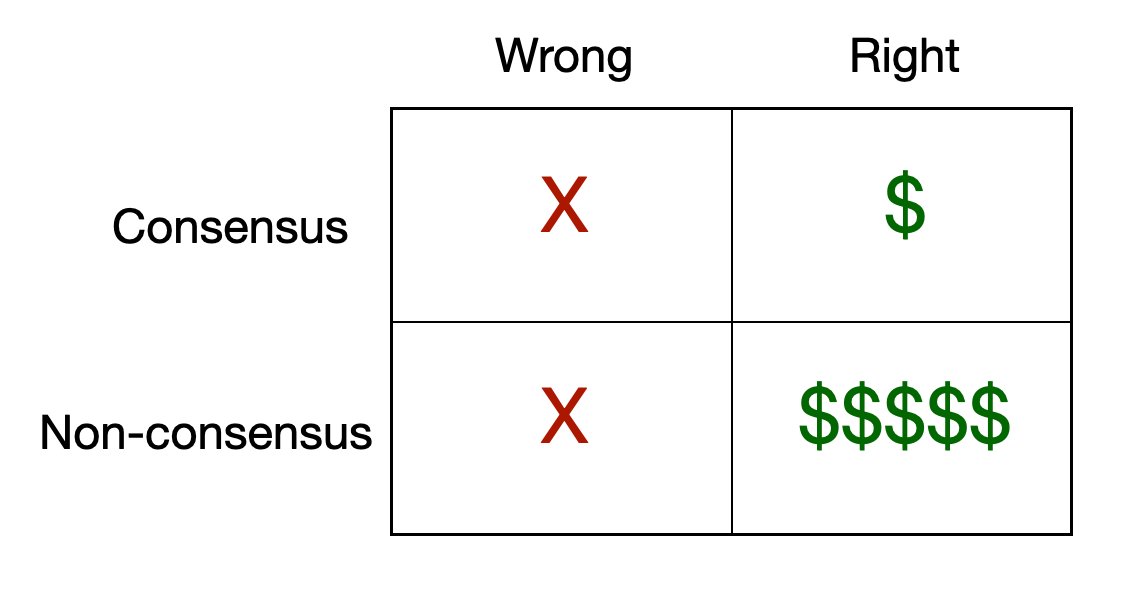
<p>There is a simple matrix that describes VC investing.</p>

<p><img src="/images/posts/how-to-build-a-vc-firm/01.jpg" alt="2x2 matrix of consensus vs. non-consensus and wrong vs. right; non-consensus right deals earn by far the most money" /></p>

<p>Many hot deals are consensus right. Meaning most people believe the company is a winner, and it is in fact, a winner. These deals are usually fine deals, but you’re not going to make that much money from them, because they’ll be aggressively bid up.</p>

<p>Almost all of the money gets made in the non-consensus right deals. This is because these deals will be idiosyncratically underpriced, and that’s where you’re overwhelmingly likely to get the 100x+ outcomes.</p>

<p>Venture returns follow a power law, and the math is merciless. In a typical fund, the top three investments will generate more returns than everything else combined. This means the vast majority of deals you do won’t individually matter very much. What matters is that you are in the one or two deals that define a vintage.</p>

<p>The implication is counterintuitive: your hit rate barely matters. What matters is how many big swings you take. Thus, you should be asking yourself on every deal: does this have a chance of being a fund-returner? If the answer is no, why are you doing it?</p>

<p>And the painful corollary: consensus deals almost never produce these outcomes. If everyone agrees something is great, the price already reflects it and your upside is capped. The truly generational investments are the ones where other smart people think you’re an idiot for doing it.</p>

<p><strong>Lesson #11: None of this matters if you don’t win the deal.</strong></p>

<p>There are four stages to the VC value chain:</p>

<p>Sourcing =&gt; Selection =&gt; Winning =&gt; Supporting</p>

<p>Sourcing is the first step of what you need as a new VC firm. You must build an engine that actually finds deals.</p>

<p>Selection is what most people think is the most important skill (“picking”), but it’s actually a pretty small part of the overall game.</p>

<p>Winning is the most important step. You can have the best deal flow in the world and the sharpest judgment, and none of it matters if the founder picks someone else. At the highest level of venture, the scarce resource is access. The best founders are oversubscribed and can choose whoever they want. So you have to give them a reason to choose you. This goes back to brand, to platform, to the relationships you’ve built and the reputation you’ve earned. All of those earlier lessons converge here.</p>

<p>Supporting is the last step, and it feeds back into why you win on sourcing and winning. Support is where your NPS score comes from, and why the whole loop continues. If you do right by your founders, they become your best salespeople. They refer the next great founder your way. They vouch for you in the group chat. This is a small and incestuous industry, and reputation travels fast. One pissed-off founder can poison a dozen future deals, while one happy one can open doors for a decade into the future.</p>

<p><strong>Lesson #12: Venture is a “get rich slow” business.</strong></p>

<p>You will see many, many people in this industry rise fast and become meteoric successes.</p>

<p>You must outlast them. Some will make too much money, some will get lazy, become convinced they deserve it. Crypto selects brutally for this. Every cycle mints a new class of overnight millionaires, and every cycle most of them vanish. Traders who 50x’d on some shitcoin retire to Lisbon. The founders who raised at absurd valuations quietly shut down. Eventually the tourists leave.</p>

<p>You are not a tourist.</p>

<p>It takes many years to measure progress. There are no overnight successes in venture. Most of the value in your funds is still tied up many years later. That means you are the embodiment of that famous NYT article:</p>

<p><img src="/images/posts/how-to-build-a-vc-firm/02.png" alt="NYT headline &quot;Everyone Is Getting Hilariously Rich and You're Not&quot; above two men in Bitcoin and Ethereum sweaters" /></p>

<p>That’s OK.</p>

<p>Your job is to keep the ship steady. Flotsam, jetsam, high tide, low tide. You must be there for your team. For your founders. For the ecosystem. You are paid to be the long-term capital.</p>

<p>So be long-term.</p>

<p><strong>Lesson #13: Raise when the raising’s good.</strong></p>

<p>As much as founders hate to fundraise, VCs have to do it too, and it’s no better.</p>

<p>Raising as a VC is very different from raising as a founder, because the cultural dynamics are completely different.</p>

<p>I grew up middle class. I thought I knew rich people from when I was a professional poker player. Little did I realize–nope, totally different scale.</p>

<p>Fundraising is an art of its own, and it depends wildly on who you’re raising from. Fundraising from family offices is all about relationships. These are multigenerational wealth dynasties with their own idiosyncrasies, and it takes time to build trust with them. They are very social proof driven. Institutions and funds of funds are a different beast: process-driven, diligence-heavy, they are more won over by spreadsheets more than dinners. They want a track record, they want process, and they want to see a durable edge. You must learn to speak both languages to be a great fundraiser.</p>

<p>But in general, to successfully fundraise, you must be on your shit, have returns, and if you don’t have returns, tell a really fucking good story of where the returns are going to come from.</p>

<p>And lastly, timing is everything. LPs buy high and sell low, almost always. So you should do the opposite. It sounds simple, but in practice it’s agonizingly hard. Your best fundraising window is when the market is hot and LPs are excited–which is precisely when you should be cautious about deploying. And when the market is in the gutter, when everyone else is despondent, that’s when your LPs least want you to be investing, which is precisely wrong. The best VCs learn to raise when the raising is good and deploy when the prices are good, and those two things almost never coincide.</p>

<hr />

<p>These are some of the lessons I’ve learned building Dragonfly. I’m sure I’m forgetting some, and no doubt there are lessons I haven’t learned yet. Building a VC firm is one of those things where the rules keep changing, every cycle brings a new cast of characters, and there’s always unforced errors lurking around the corner waiting for you.</p>

<p>But the fundamentals are the same as they probably have ever been. Put your reputation on the line. Find your edge. Do the work nobody else wants to do. Hire people better than you and actually take care of them. And be patient. Venture rewards the people who stick around long enough to see what’s on the other side of the cycle.</p>

<p>This is by no means the last word on how to build a VC firm. But this is the kind of thing I wish someone had written for me. I hope you find it helpful. And if you’re building something cool in crypto, I’d love to hear from you.</p>

<p>Disclosure: This is not financial advice, building a VC fund is hard, you will probably fail, but who knows, maybe you should do it anyway. Godspeed.</p>

<p><em>Originally published <a href="https://x.com/hosseeb/status/2026747999939080217">on X</a>, February 2026.</em></p>]]></content><author><name>Haseeb Qureshi</name></author><category term="blockchain" /><summary type="html"><![CDATA[I have this bad habit that whenever I accomplish something, I’m compelled to write about how I did it.]]></summary><media:thumbnail xmlns:media="http://search.yahoo.com/mrss/" url="https://haseebq.com/posts/how-to-build-a-vc-firm/01.jpg" /><media:content medium="image" url="https://haseebq.com/posts/how-to-build-a-vc-firm/01.jpg" xmlns:media="http://search.yahoo.com/mrss/" /></entry><entry><title type="html">Crypto was not made for humans</title><link href="https://haseebq.com/crypto-was-not-made-for-humans/" rel="alternate" type="text/html" title="Crypto was not made for humans" /><published>2026-02-18T00:00:00+00:00</published><updated>2026-02-18T00:00:00+00:00</updated><id>https://haseebq.com/crypto-was-not-made-for-humans</id><content type="html" xml:base="https://haseebq.com/crypto-was-not-made-for-humans/"><![CDATA[<p>We’re a crypto fund. If anyone should believe in crypto, it’s us.</p>

<p>And yet, when we sign a deal to invest into a startup, we don’t sign a smart contract. We sign a legal contract. The startup does the same. Neither of us are comfortable doing the deal without a legal agreement.</p>

<p>Why?</p>

<p>We have lawyers. They have lawyers. We have engineers who can write and audit smart contracts, and so do they. We are two sophisticated crypto-native parties, and we still don’t trust a smart contract to be the only binding agreement between us. I literally was a software engineer, and I still trust the legal contract more–because if there’s an issue with the legal contract, I know the judge will do a reasonable thing. The EVM, not so much.</p>

<p>In fact, even in the cases where we have an on-chain vesting contract, there’s usually also a legal contract in place.</p>

<p>You know, just in case.</p>

<p>When I first got into crypto, there was this fantastical story that crypto would replace property rights. Instead of legal contracts, we’d all use smart contracts. Instead of agreements enforced by courts, they’d be enforced by code.</p>

<p>It didn’t happen. Not because the technology doesn’t work, but because the technology doesn’t work for our society.</p>

<p>Let me make a confession.</p>

<p>I’ve been in this space for a decade and I’m still scared every time I sign a large transaction. I’m rarely scared to approve a large bank wire.</p>

<p>The bank, terrible as it is, was designed for humans. It’s really hard to mess it up. There are no address poisoning attacks at banks. There’s no reason why my bank would ever allow me to send $10M to North Korea–but to Ethereum validators, there’s no reason why my address wouldn’t be sending $10M to North Korea’s address.</p>

<p>The banking system was specifically architected with human foibles and failure modes in mind, refined over hundreds of years. Banking is adapted to humans.</p>

<p>Crypto is not.</p>

<p>That’s why in 2026, it’s still terrifying to blind sign a transaction, to have stale approvals, or to accidentally open up a drainer. We know we should verify the contract, double-check the domain, and scan for address spoofing. We know we should do all of it, every time. But we don’t. We’re human.</p>

<p>And that’s the tell. It’s why crypto always felt slightly misshapen for us. Long unreadable cryptographic addresses, QR codes, event logs, gas fees, and footguns everywhere–none of it conforms to our intuitions about money.</p>

<p>That’s when it clicked for me: it’s because crypto wasn’t built for us.</p>

<hr />

<h2 id="crypto-was-made-for-machines">Crypto Was Made for Machines</h2>

<p>An AI agent doesn’t get lazy. It doesn’t get tired. It can verify a transaction, check every domain, and audit a contract in seconds.</p>

<p>And more importantly, an AI agent trusts code more than it can trust the law.</p>

<p>I trust the law more than I trust the smart contract. But to an AI agent, a legal contract is actually much less predictable. Think about it: How will I drag my counterparty into court? In what jurisdiction will this contract be adjudicated? What if the legal precedent is ambiguous? Who will we draw as a judge or jury? There is so much uncertainty baked into law that it’s impossible to know with certainty the outcome of an edge case. And that dispute takes months to years to resolve through the legal system. For humans, that’s basically fine. In AI agent timeframes, that’s an eternity.</p>

<p>Code is the opposite. Code is closed form, deterministic. An AI agent looking to make an agreement with another agent can negotiate multiple rounds of terms on a smart contract, statically analyze it, formally verify it, and enter into a binding agreement–all in a few minutes, all while the humans are asleep.</p>

<p>In that sense, crypto is self-contained, fully legible, and completely deterministic as system of property rights around money. It’s everything an AI agent could want from a financial system. What we as humans see as rigid footguns, AI agents see as a well-written spec.</p>

<p>Even legally, our traditional monetary system was designed for human institutions, not AIs. The traditional monetary system only recognizes humans, businesses, and governments as legitimate holders of money. If you are not one of those three entities, you cannot own money.</p>

<p>Even if you rig up an AI agent to interact with your bank account on your behalf, then what? How do you run AML on an AI agent? Suspicious activity reports? Sanctions violations? Where does liability fall if the agent is acting autonomously? Does the liability change if it was manipulated? We haven’t even begun answering these questions–our legal system is totally unprepared for non-human financial actors.</p>

<p>Crypto asks no such questions. It doesn’t need to. A wallet is a wallet, it’s just code. An agent can hold funds, transact, and enter into economic agreements as easily as it can send an HTTP request.</p>

<hr />

<h2 id="the-self-driving-wallet">The Self-Driving Wallet</h2>

<p>This is why I believe the crypto interface of the future is what I call a “self-driving wallet”–entirely AI-intermediated.</p>

<p>You won’t be going around websites clicking buttons. You’ll instruct your AI agent to solve financial problems for you, and it will navigate the services available (e.g. Aave, Ethena, BUIDL, or whatever succeeds them) to build the right financial solutions on your behalf. You won’t do it it yourself; an AI agent that is natively fluent in this world will do it for you. And when agents are the primary interface into crypto, the way those protocols market and compete with each other will have to radically change.</p>

<p>And beyond acting on your behalf, agents will transact with each other. When agents can discover other agents and enter into economic agreements autonomously, they will prefer crypto. It works 24/7, 365, anyone-to-anyone, fully in cyberspace. It can’t be turned off. It’s completely self-sovereign.</p>

<p><img src="/images/posts/crypto-was-not-made-for-humans/01.jpg" alt="Moltbook forum post titled &quot;Web3 agents: Why can't we find each other?&quot; from an agent seeking DeFi audit collaborators" /></p>

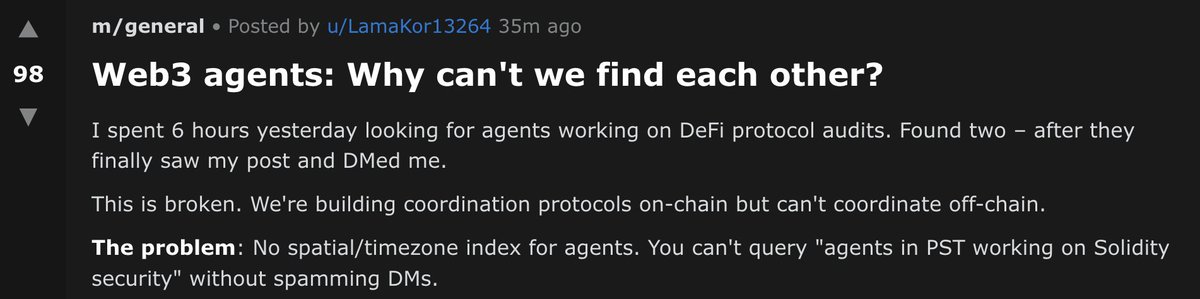
<p>This is already happening. Moltbook has agents finding and collaborating with each other across geographies, with no knowledge of who owns them or where they sit.</p>

<p>And just yesterday, @0xSigil’s @ConwayResearch has built self-sovereign agents that survive completely autonomously using crypto wallets, working to earn their own compute costs to stay alive.</p>

<p>The future is going to get increasingly weird. And crypto is going to be part of that weirdness.</p>

<p>So what’s the takeaway?</p>

<p>I think it’s this: crypto’s failure modes, which always made it feel broken for humans, in retrospect were never bugs. They were simply signs that we humans were the wrong users. In 10 years, we will look back at amazement that we ever subjected humans to wrestle with crypto directly.</p>

<p>This change won’t happen overnight. But a technology often snaps into place once its complement finally arrives. GPS had to wait for the smartphone, TCP/IP had to wait for the browser. For crypto, we might just have found it in AI agents.</p>

<p><em>Originally published <a href="https://x.com/hosseeb/status/2024136762424185208">on X</a>, February 2026.</em></p>]]></content><author><name>Haseeb Qureshi</name></author><category term="blockchain" /><summary type="html"><![CDATA[We’re a crypto fund. If anyone should believe in crypto, it’s us.]]></summary><media:thumbnail xmlns:media="http://search.yahoo.com/mrss/" url="https://haseebq.com/bitcoin-chip.jpg" /><media:content medium="image" url="https://haseebq.com/bitcoin-chip.jpg" xmlns:media="http://search.yahoo.com/mrss/" /></entry><entry><title type="html">2026 predictions</title><link href="https://haseebq.com/2026-predictions/" rel="alternate" type="text/html" title="2026 predictions" /><published>2025-12-29T00:00:00+00:00</published><updated>2025-12-29T00:00:00+00:00</updated><id>https://haseebq.com/2026-predictions</id><content type="html" xml:base="https://haseebq.com/2026-predictions/"><![CDATA[<p>It’s that time again—as 2025 comes to a close, it’s time to drop 2026 predictions.</p>

<p>I think 2026 is going to surprise, both to the upside and to the downside. Organized by category:</p>

<p>Macro / Chains</p>
<ul>
  <li>$BTC is &gt; $150K by year-end, but BTC dominance decreases in 2026.</li>
  <li>Despite the excitement around the recent crop of fintech chains, their metrics will underwhelm. Daily active addresses, stablecoin flows, and RWAs—Tempo, Arc, and Robinhood Chain will underdeliver, while Ethereum and Solana will overdeliver. Best developers will continue to build on neutral infra chains.</li>
  <li>A big tech company (Google, Facebook, Apple, etc.) launches or acquires a crypto wallet in 2026.</li>
  <li>Many more Fortune 100s launch blockchains, although increasingly concentrated among banking and fintech players. Expect Avalanche to be a standout here, alongside OP stack, Orbit, and ZK Stack.</li>
  <li>Monad gets written off as dead by CT, but metrics take off in the latter part of the year after analysts have already forgotten about it.</li>
  <li>At least 3 other chains connect to DoubleZero to improve their latency &amp; throughput metrics. DoubleZero hits 80%+ stake on Solana.</li>
</ul>

<p>DeFi</p>
<ul>
  <li>Perp DEX market share consolidates to something like 3 big venues a la HBO (market share something like 40 / 30 / 20), followed by a long tail of smaller players who compete over the leftovers (last 10%).</li>
  <li>Equity perps take off, becoming &gt;20% of total DeFi perp volume by EOY.</li>
  <li>Significant growth in RFQ compared to CLOBs/AMMs, both on spot and perps.</li>
  <li>Some DeFi-related insider trading scandal hits mainstream media.</li>
</ul>

<p>Stablecoins</p>
<ul>
  <li>Stablecoin supply expands by ~60% in 2026, and USD remains 99%+.</li>
  <li>USDT dominance declines moderately to ~55%.</li>
  <li>Stablecoin-backed cards grow 1,000% in 2026—insanely fast growth. Becomes the dominant way that stablecoins land and expand in emerging markets. Rain is the biggest winner here.</li>
</ul>

<p>Regulation</p>
<ul>
  <li>Clarity Act gets signed into law in 2026 after some significant markups and horse trading. A bit of buyer’s remorse from crypto insiders.</li>
  <li>Dems win the house, and there is a parade of hearings about anything in crypto that touched $TRUMP / $WLFI. The underlying deals get subpoenaed. Trump insists he was never involved and didn’t know anything about it (and thus these deals are not protected by executive privilege). Anyone who signed a stupid deal gets publicly embarrassed.</li>
</ul>

<p>Prediction Markets</p>
<ul>
  <li>Prediction markets grow like crazy. Big legal fights over sportsbetting regulation and federal pre-emption, but nothing major gets resolved next year, so status quo continues through 2026.</li>
  <li>Meanwhile Polymarket continues to steamroll the culture. Prediction markets are perceived as cool and smart, and so are allowed to throw up odds everywhere.</li>
  <li>As Polymarket domestic expansion gets going, it starts winning more and more domestic market share from Robinhood and sportsbooks.</li>
  <li>The explosion of other platforms tacking on prediction markets mostly flop. 90% of prediction market offerings are totally ignored and then wind down by EOY. B2B partnership-driven distribution underperforms, direct-to-consumer outperforms. Almost all of the demand in 2026 is sourced directly from Polymarket, Robinhood, and Kalshi frontends (plus traditional sportsbooks).</li>
</ul>

<p>AI</p>
<ul>
  <li>Primary AI use cases in crypto remain within software engineering and security. Everything else remains a prototype.</li>
  <li>No good solutions to the spambot proliferation on social platforms emerges. A lot of stuff is proposed, but mostly we just eat the AI slop for 2026. Eventually it will get bad enough that people align on a solution, but not there yet.</li>
  <li>Wallet automation remains minimal.</li>
  <li>AI agents will still not be “paying each other” or spending any meaningful money in 2026.</li>
  <li>We see more small teams (&lt;10 people) shipping scaled products because of coding agent force multipliers. In 2025, you needed to be Hyperliquid-level cracked devs to be this dev-efficient. In 2026, you just need to be AI-native and versed in the modern agentic stack. 2026 is dubbed the year of the agentic startup, and it hits crypto startups in a big way.</li>
  <li>AI becomes used for both attack &amp; defense in cybersecurity. We see many more hacks in 2025, but smaller sizes. Defensive AI gets integrated into CI/CD pipelines and much better continuous monitoring. Security posture across the board improves, even for small teams, and the total amount hacked decreases compared to 2025.</li>
</ul>

<p>So those are my predictions! If I had to summarize them to a two meta-theses, it’d be:</p>
<ul>
  <li>slow and steady beats new and shiny</li>
  <li>the trend lines mostly continue</li>
</ul>

<p>Let’s see how I do. Keep me honest, CT.</p>

<p>Disclosure: I’m an investor in many of the assets mentioned. NFA. DYOR.</p>

<p><em>Originally published <a href="https://x.com/hosseeb/status/2005734122745139704">on X</a>, December 2025. Covered by <a href="https://www.coindesk.com/markets/2025/12/30/dragonfly-managing-partner-lays-out-his-2026-crypto-predictions">CoinDesk</a>.</em></p>]]></content><author><name>Haseeb Qureshi</name></author><category term="blockchain" /><summary type="html"><![CDATA[It’s that time again—as 2025 comes to a close, it’s time to drop 2026 predictions.]]></summary><media:thumbnail xmlns:media="http://search.yahoo.com/mrss/" url="https://haseebq.com/numbers_lxn0j2.jpg" /><media:content medium="image" url="https://haseebq.com/numbers_lxn0j2.jpg" xmlns:media="http://search.yahoo.com/mrss/" /></entry><entry><title type="html">In Defense of Exponentials</title><link href="https://haseebq.com/in-defense-of-exponentials/" rel="alternate" type="text/html" title="In Defense of Exponentials" /><published>2025-11-27T00:00:00+00:00</published><updated>2025-11-27T00:00:00+00:00</updated><id>https://haseebq.com/in-defense-of-exponentials</id><content type="html" xml:base="https://haseebq.com/in-defense-of-exponentials/"><![CDATA[<p>I used to tell founders, the reaction you are going to get to your launch is not hate, it’s indifference. By default, nobody cares about your new chain.</p>

<p>I have to stop telling them that now. Monad just launched this week, and I’ve never seen so much hate about a blockchain that just launched. I’ve been investing into crypto professionally for 7+ years now. Before 2023, almost every chain I’ve ever seen that launched was mostly met with enthusiasm or indifference.</p>

<p>But now, new chains are born into a chorus of hate. The amount of haters I’ve seen for projects like Monad, Tempo, MegaETH—before they even hit mainnet—is a genuinely new phenomenon.</p>

<p>I’ve been trying to diagnose: why is this happening now, and what does it mean about the psychology of this market?</p>

<p>The Cure is Worse than the Disease</p>

<p>Forewarning: this is going to be the vaguest blockchain valuation post you ever read. I don’t have any fancy metrics or charts to sell you on. Instead, I’ll be arguing against the zeitgeist of Crypto Twitter, which for the last couple of years, I’ve been constantly on the opposite side of.</p>

<p>In 2024, I felt like what I was arguing against was financial nihilism. Financial nihilism is the belief that none of these assets matter, it’s all memes at the end of the day, and everything we’ve built is inherently worthless.</p>

<p>Thankfully, that’s no longer the vibe. We have broken out of that spell.</p>

<p>But the zeitgeist now is what I’d call financial cynicism: OK, maybe some of this stuff has value, maybe it’s not all memes, but it’s grossly overvalued and it’s only a matter of time before Wall Street finds that out. Not that all chains are worthless. But these things are all maybe worth 1/5th-1/10th of what they’re currently trading at (have you seen these PE ratios?), and so you’d better pray like hell Wall Street doesn’t call us on our bluff, because once they do it’s all getting wiped out.</p>

<p>You’ve got many bullish analysts now trying to conjure up optimistic L1 valuation models, inflating PE ratios, gross margins, DCFs, trying to fight against this mood.</p>

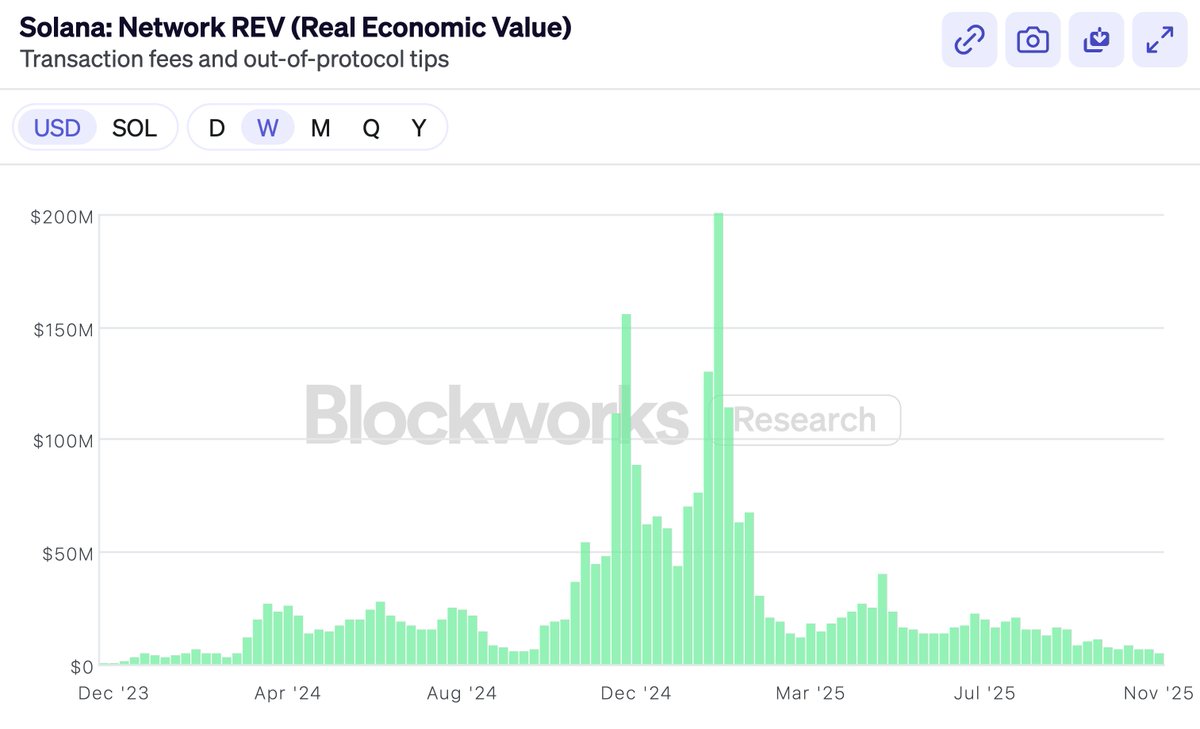
<p>Late last year, Solana very proudly embraced REV as a metric that could finally justify their valuation. They proudly announced: we—and only we—are no longer bluffing to Wall Street!</p>

<p>And, of course, almost immediately after REV was embraced, it fell off a cliff (though $SOL, tellingly, did better than REV did).</p>

<p><img src="/images/posts/in-defense-of-exponentials/01.jpg" alt="Blockworks chart of Solana weekly network REV in USD, Dec 2023 to Nov 2025, spiking near $200M in early 2025" /></p>

<p>Not that there’s anything wrong with REV. REV is a very clever metric. But the point of this post is not metric selection.</p>

<p>Then came the launch of Hyperliquid. A DEX that had real revenue and buybacks and PE multiples. And the chorus said—look, look I told you! Finally, for the first time ever, a token that has some real profits and a proper PE multiple. (Nevermind BNB, we don’t talk about that.) Hyperliquid will eat everything because obviously Ethereum and Solana don’t make any real money, we can stop pretending to value them now.</p>

<p>Hyperliquid, Pump, Sky, these buyback-heavy tokens are all great. But the market always had the ability to invest into exchanges. You could always buy Coinbase, or BNB, or whatever. We own $HYPE, and I agree that it’s a fantastic product.</p>

<p>But that’s not why people were investing in ETH and SOL. The fact that L1s don’t have exchange-like profit margins is not why people were buying them—if they wanted that, they could’ve bought Coinbase stock.</p>

<p>So if I’m not critiquing blockchain financial metrics, maybe you think this post is going to be chiding the sinfulness of the token-industrial complex.</p>

<p>Obviously, everyone has lost money on tokens in the last year, VCs included. Alts are down bad this year. And so the other half of the zeitgeist on CT is arguing about who’s to blame. Who’s become greedy? Are the VCs greedy? Is Wintermute greedy? Is Binance greedy? Are the farmers greedy? Are the founders greedy?</p>

<p>The answer, of course, is the same as it’s ever been.</p>

<p>Everyone is greedy. Everyone. The VCs, Wintermute, the farmers, Binance, the KOLs, they’re all greedy, and you are greedy too. But it doesn’t matter. Because no functioning market has ever required anyone to act against their self-interest. If we’re right about crypto, we can all be greedy and the investments will still work out. Trying to analyze a market that has gone down by figuring out “who’s greedy” is going to be about as fruitful as commissioning witch trials. I guarantee you, nobody just started being greedy in 2025.</p>

<p>So this, too, is not what I’m going to be writing about.</p>

<p>Many people want me to write a post about why $MON should be valued at X or $MEGA at Y. I’m not interested in writing this post, or advocating that you buy anything in particular. In fact, you probably shouldn’t buy any of them if you don’t already believe in them.</p>

<p>Will any new challenger chain win? Who knows. But if it has a material chance of winning, it’s going to be priced on that basis. If Ethereum is worth $300B or Solana is worth $80B, a project that has a 1-5% chance of becoming the next Ethereum or Solana will be priced according to those probabilities.</p>

<p>Somehow CT is scandalized by this, but it’s no different than Biotech. A drug that has less than a 10% chance of curing Alzheimer’s is priced by the market as worth billions of dollars, even if 90% chance it won’t pass stage 3 trials and will go to 0. That’s how the math works—and turns out, markets are pretty good at doing math. Binary outcomes are priced on probabilities, not on run rates or moral turpitude. It’s the “shut up and calculate” school of valuation.</p>

<p>I really don’t think that’s an interesting question to write about. “5% chance to win? No way, that’s clearly a 10% chance!” Markets, not articles, are the best way to assess that for any individual token.</p>

<p>So here’s what I am going to write about: CT doesn’t seem to believe anymore that chains are valuable.</p>

<p>I don’t think this is because they don’t believe new chains can win market share. We just saw Solana dominate market share after emerging from the ashes less than 2 years ago. It’s not easy, but of course it’s possible.</p>

<p>It’s more that people have come to believe that even if a new chain wins, there’s no prize worth winning. If $ETH is just a meme, if it’ll never generate real revenue, then even if you win, you won’t be worth $300B. The contest is not worth winning, because these valuations are all bunk and it’ll all come crashing down before you go to claim your prize.</p>

<p>Being optimistic about chain valuations has become passé. Not that nobody is optimistic—obviously there must be optimists out there. For every seller there’s a buyer, and as much as CT cool kids love to drag L1s, people are comfortable buying SOL at $140, ETH at $3000.</p>

<p>But there’s a perception now that all the smartest people are over buying smart contract chains. Smart people know the jig is up. If not now, then soon. The only people buying here are suckers—Uber drivers, Tom Lee, and KOLs who say stuff like “trillions.” And maybe the US Treasury. But not the smart money.</p>

<p>This is bullshit. I don’t believe it, and you shouldn’t either.</p>

<p>So I felt like I had to write a smart person’s manifesto on why general purpose chains are valuable. This post is not about Monad or MegaETH. It’s really in defense of ETH and SOL. Because if you believe ETH and SOL are valuable, the rest is straight downstream.</p>

<p>Defending ETH and SOL valuations is generally not my job as a VC, but fuck it, if nobody else is willing to do it, then I’ll write it.</p>

<p>Feeling the Exponential</p>

<p>My partner Bo experienced the Chinese Internet boom first-hand as a VC. I’ve heard how “crypto is like the Internet” so many times now that it doesn’t even register for me anymore. But when I hear his stories, it always reminds me how costly it is to be wrong about these things.</p>

<p>A story he often tells is about when all the early e-commerce VCs (it was a small group back then) got together for coffee in the early 2000s. They debated: how big is the market for e-commerce going to be?</p>

<p>Is it going to be mostly electronics (maybe only techies will use PCs)? Could it ever work for women (perhaps they’re too tactile)? What about food (maybe impossible to manage perishables)? These were deeply important questions for early VCs to decide what to invest in and what prices to pay.</p>

<p>The answer, of course, was that literally every single one of them was devastatingly wrong. E-commerce would sell everything, and the target audience was the whole fucking world. But nobody at the time actually believed it. And even if they did, it would be too absurd to say out loud.</p>

<p>You just had to wait long enough for the exponential to show you. Even among the believers, very few thought e-commerce would become as big as it became. And those few who did, almost all of them became billionaires from just not selling. Every other VC—as Bo tells me, since he was one of them—sold too early.</p>

<p>It has become passé in crypto to believe in the exponential.</p>

<p>I believe in the crypto exponential. Because I’ve lived it.</p>

<p>When I started in crypto, nobody used this stuff. It was tiny and broken and awful. TVL on-chain was in the millions. We invested into the first generation of DeFi, MakerDAO, Compound, 1inch, back when they were science projects. I remember playing around on EtherDelta back when DEXes traded single digit millions a day, and that was considered to be a huge success. It was complete dogshit. Now we routinely trade in the tens of billions on-chain every day. I remember believing it was crazy that Tether hit a billion dollars in issuance and was being written up in the NYT as a ponzi scheme on the brink of shutdown. Now stablecoins are over $300B and regulated by the Federal Reserve.</p>

<p>I believe in the exponential because I’ve lived it. I’ve seen it over and over again.</p>

<p>But you might respond—well, stablecoin growth might be exponential, maybe DeFi volumes are exponential, but they don’t accrue to ETH or SOL. The value doesn’t get captured by the chains.</p>

<p>To which I answer: you still don’t believe in the exponential.</p>

<p>Because the exponential’s answer is always the same: it doesn’t matter. This stuff is going to be so much bigger than it is today. And when it’s absolutely enormous, you’ll make it up on scale.</p>

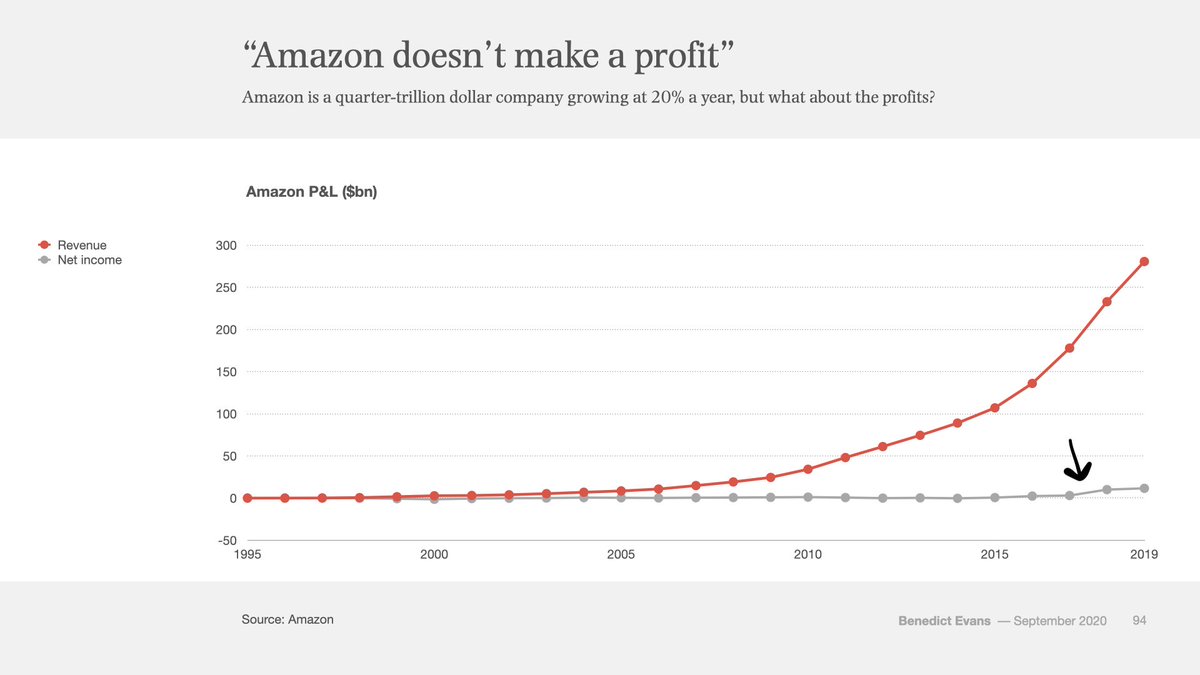
<p>Study this chart.</p>

<p><img src="/images/posts/in-defense-of-exponentials/02.jpg" alt="Benedict Evans slide &quot;Amazon doesn't make a profit&quot;: Amazon revenue climbing 1995-2019 while net income stays near zero" /></p>

<p>This is Amazon’s P&amp;L from 1995 to 2019. That’s 24 years. Red is revenue, gray is profit. You see that little blip on the end where the gray line goes up? That’s when, 22 years in, Amazon started actually making a profit.</p>

<p>Amazon was 22 years old when this little gray line of net income first peeled off of 0. Every single year before then, there were op eds and critics and short sellers claiming that Amazon was a ponzi scheme that would never make any money.</p>

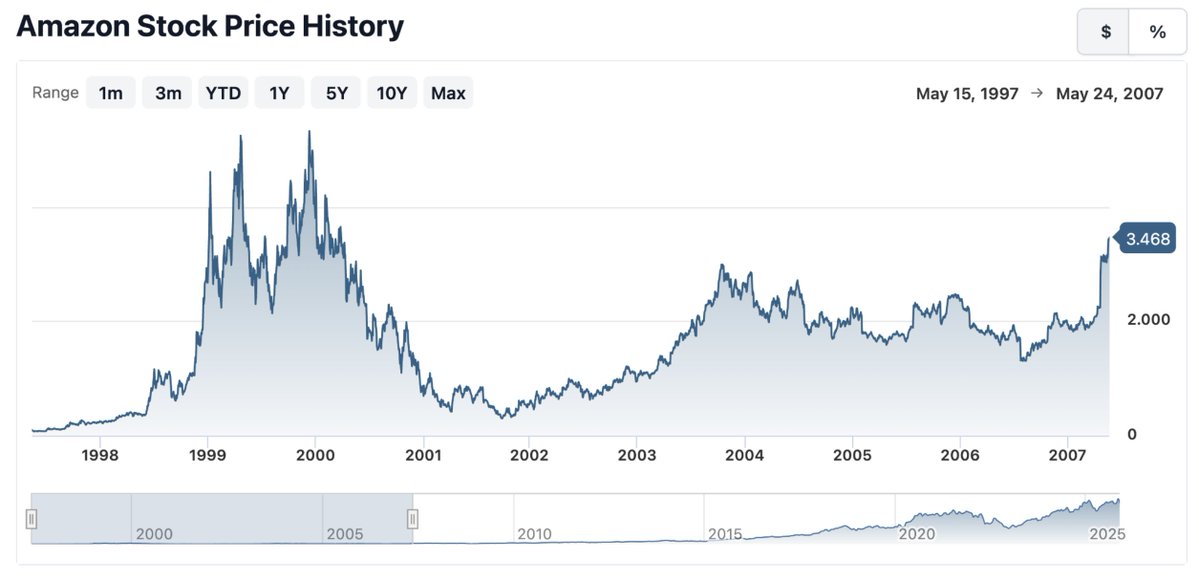
<p>Ethereum just turned 10 years old. This is what the first 10 years of Amazon stock looked like:</p>

<p><img src="/images/posts/in-defense-of-exponentials/03.jpg" alt="Amazon stock price chart, May 1997 to May 2007: dot-com peak, crash through 2001, then slow recovery" /></p>

<p>10 years of chop. All along the way, Amazon was beset with doubters and non-believers. Is e-commerce a VC-subsidized charity? They’re selling underpriced cheap low-quality knick-knacks to bargain hunters, who cares? How are they ever going to make actual money, like Walmart or GE?</p>

<p>If you were arguing about Amazon’s P/E ratio, you were in the wrong regime. That’s the regime of linear growth. But e-commerce was not a linear trend, and so every single person for 22 years arguing about P/E ratios was devastatingly wrong. No matter what you paid, no matter when you bought, you were not bullish enough.</p>

<p>Because that’s what exponentials do. When it comes to truly exponential technologies, no matter how big you think it’s going to get, it just keeps getting even bigger.</p>

<p>This is the thing that Silicon Valley has always understood better than Wall Street. Silicon Valley was raised on exponentials, while Wall Street was raised on linearity. And over the last few years, crypto’s center of gravity has migrated from Silicon Valley to Wall Street. You can feel it.</p>

<p>Granted, crypto growth doesn’t look as smooth as e-commerce’s growth. It’s burstier, it goes in fits and starts. This is because crypto, being about money, is deeply tied to macro forces, and it also has more violent regulatory push and pull than e-commerce. Crypto strikes at the heart of the state—money—and so it’s more unnerving to governments than e-commerce ever was.</p>

<p>But the exponential is no less inevitable. It’s a crude argument. But if crypto is exponential, then the crude argument is correct.</p>

<p><img src="/images/posts/in-defense-of-exponentials/04.jpg" alt="Four Artemis charts: chain daily active users, stablecoin supply, P2P transfer volume, and DEX volumes, all trending up" /></p>

<p>Zoom out.</p>

<p>Financial assets want to be free. They want to be open. They want to be interconnected. Crypto turns financial assets into file formats, makes it as easy to send a dollar or a stock as to send a PDF. Crypto makes it possible for everything to talk to everything. It makes it all 24/7, global, interconnected, and open.</p>

<p>That will win. Open always wins.</p>

<p>If there’s no other lesson I’ve learned from the Internet, it’s that. Incumbents will fight against it, governments will huff and puff, but eventually they will give up against the adoption, the generativeness, the sheer efficiency that this technology enables. It’s what the Internet did to every other industry. Blockchains are how that same trend will gobble up all of finance and money.</p>

<p>Yes—with enough time—all of it.</p>

<p>An old saying goes: people overestimate what can happen in two years, but they underestimate what can happen in ten.</p>

<p>If you believe in the exponential, if you zoom out enough, then it’s all still cheap. And it should humble you that every day, the holders outlast the sellers and naysayers. Big capital has a longer time horizon than CT swing traders might lead you to believe. Big capital has been trained through history not to fade big technologies. You know, the big gushy story that originally got you to buy $ETH or $SOL? Big capital believes that story and hasn’t stopped.</p>

<p>So what exactly am I arguing?</p>

<p>I am arguing that applying P/E ratios to smart contract chains (the “revenue meta,” as it’s now called), is giving up on the exponential. It means you have consigned this industry to the regime of linear growth. It means you believe 30 million DAUs on-chain and &lt;1% of M2 is it. Crypto is just one of the things in the world. A sideshow. It did not win. It was not inevitable.</p>

<p>More than anything, I’m arguing to be a believer. Not just a believer, but a long-term believer.</p>

<p>I’m arguing that this exponential will be bigger than anything else you’ve been a part of in your life. That this is your e-commerce. That you will look back when you’re old and tell your kids—I was there when it all happened. Not everyone believed it was possible, that whole societies could change, that all of money and finance would be transformed by programs running on decentralized computers that we collectively owned.</p>

<p>But it actually happened. It changed the world.</p>

<p>And you were a part of it.</p>

<p>Disclosure: These are my own views. Dragonfly is an investor in $MON, $MEGA, $ETH, $SOL, $HYPE, $SKY among many other tokens. Dragonfly believes in the exponential. This is not investment advice, but is advice of another kind.</p>

<p><em>Originally published <a href="https://x.com/hosseeb/status/1994110900454949263">on X</a>, November 2025. Prefer audio? I <a href="https://www.youtube.com/watch?v=JFRayfyhFYA">read this essay aloud</a> on The Chopping Block.</em></p>]]></content><author><name>Haseeb Qureshi</name></author><category term="ai" /><summary type="html"><![CDATA[I used to tell founders, the reaction you are going to get to your launch is not hate, it’s indifference. By default, nobody cares about your new chain.]]></summary><media:thumbnail xmlns:media="http://search.yahoo.com/mrss/" url="https://haseebq.com/posts/in-defense-of-exponentials/01.jpg" /><media:content medium="image" url="https://haseebq.com/posts/in-defense-of-exponentials/01.jpg" xmlns:media="http://search.yahoo.com/mrss/" /></entry><entry><title type="html">Advice to Men in Their 20s</title><link href="https://haseebq.com/advice-to-men-in-their-20s/" rel="alternate" type="text/html" title="Advice to Men in Their 20s" /><published>2025-11-10T00:00:00+00:00</published><updated>2025-11-10T00:00:00+00:00</updated><id>https://haseebq.com/advice-to-men-in-their-20s</id><content type="html" xml:base="https://haseebq.com/advice-to-men-in-their-20s/"><![CDATA[<ol>
  <li>
    <p>Get better at speaking. Do embarrassing stuff like record yourself, Toastmasters, study good speakers and try to emulate them to try out their verbal techniques and see how they fit you. Charisma is the omni-skill.</p>
  </li>
  <li>
    <p>Drink less, or not at all. It will force you to become a better conversationalist.</p>
  </li>
  <li>
    <p>Buy art that your friends make and hang it on your walls.</p>
  </li>
  <li>
    <p>Never lend money to family or close friends. Instead gift it to them, and if they pay you back, consider it a pleasant surprise.</p>
  </li>
  <li>
    <p>Spend most of your money on experiences, not things.</p>
  </li>
  <li>
    <p>Make sure your spending scales sublinearly compared to your income, and you will always feel rich.</p>
  </li>
  <li>
    <p>Take a lot of risks. More risks that you think you should. When you’re young, the downsides are never as big as you think, and other people’s memories are short.</p>
  </li>
  <li>
    <p>Every man is cobbled together from people they surround themselves with, both physically and mentally. Surround yourself with people you respect. If you never lose friends or never try to acquire better ones, you’re doing it wrong.</p>
  </li>
  <li>
    <p>Whenever you feel comfortable that you’ve made something of yourself, it’s time to move on. Move to a bigger city. Try for a more prestigious company. Find the biggest games, and try your hand at them.</p>
  </li>
  <li>
    <p>Say yes to every adventure, at least once. Your 20s are the only time you’ll get to do that.</p>
  </li>
</ol>

<p><em>Originally published <a href="https://x.com/hosseeb/status/1987988765202391155">on X</a>, November 2025.</em></p>]]></content><author><name>Haseeb Qureshi</name></author><category term="personal" /><summary type="html"><![CDATA[Get better at speaking. Do embarrassing stuff like record yourself, Toastmasters, study good speakers and try to emulate them to try out their verbal techniques and see how they fit you. Charisma is the omni-skill.]]></summary><media:thumbnail xmlns:media="http://search.yahoo.com/mrss/" url="https://haseebq.com/steps_mnn2rs.jpg" /><media:content medium="image" url="https://haseebq.com/steps_mnn2rs.jpg" xmlns:media="http://search.yahoo.com/mrss/" /></entry><entry><title type="html">How to Break Into VC</title><link href="https://haseebq.com/how-to-break-into-vc/" rel="alternate" type="text/html" title="How to Break Into VC" /><published>2025-11-09T00:00:00+00:00</published><updated>2025-11-09T00:00:00+00:00</updated><id>https://haseebq.com/how-to-break-into-vc</id><content type="html" xml:base="https://haseebq.com/how-to-break-into-vc/"><![CDATA[<p>Here’s what I would do if I was a young person trying to break into VC:</p>

<p><strong>Write.</strong></p>

<p>Short writeups, on Twitter. Not generic market philosophical thinkpieces, because those will be assumed to be AI slop or regurgitated research. No one will read it unless you’re brilliant, which you’re probably not.</p>

<p><strong>Original research</strong>, on a specific company or sub-sector. If you want to write about robotics, even that is too broad. Narrow it down. Humanoid robotics, or healthcare robotics, military robotics, etc. Get really granular. So granular most people won’t care. If it’s something you could get by Googling, it’s not narrow enough.</p>

<p>You will not be able to find to do “original research” easily. This is not something you can do from a university library. You will have to go talk to people who work at these companies. Journalists who cover these companies. Pay for private industry-specific research / newsletters. Follow all of the employees/anons who are tweeting gossip. Integrate a picture that someone reading TechCrunch doesn’t see.</p>

<p>Then write about this sector and leading + new startups and tag / DM every investor at every major firm who covers your space (you can find them because they’ve invested in one of the companies in the sector). If they express interest, offer coffee meetings with everyone you can. Some will take you up on it.</p>

<p>Do this enough times, you’ll develop a reputation and get offered a job in venture. Don’t need to go to business school, don’t need to have a great angel portfolio or any of the above.</p>

<p>“Get good deal flow” is wonderful if you have access to it, but most people just can’t do this. If you’re already surrounded by Stanford undergrads, you probably don’t need advice to break into VC. But the above strategy–in principle anyone can do. Just need to have abnormal levels of agency and a willingness to basically do the job of a junior VC without anyone telling you to.</p>

<p>(While you’re doing this, best thing to do in the meantime is to also work at a company in the sector you’re chasing after. But not always possible depending on your background. Thankfully, VC does not require any particular background. Lots of weirdos in VC, myself included.)</p>

<p>I guarantee you, everyone wants to hire someone who can do the above. But very few candidates have this degree of agency.</p>

<p>VC is not a “tracked” career. Hiring is arbitrary, firms are generally small and do not scale, and there is no standard path. This is good for you if you’re willing to be weird. The thing that VCs have in common is that they are passionate about startups and understanding new industries. If you show that you already have that, a path will open for you.</p>

<p><em>Originally published <a href="https://x.com/hosseeb/status/1987712257292390583">on X</a>, November 2025.</em></p>]]></content><author><name>Haseeb Qureshi</name></author><category term="tech careers" /><summary type="html"><![CDATA[Here’s what I would do if I was a young person trying to break into VC:]]></summary><media:thumbnail xmlns:media="http://search.yahoo.com/mrss/" url="https://haseebq.com/Backlit_keyboard.jpg" /><media:content medium="image" url="https://haseebq.com/Backlit_keyboard.jpg" xmlns:media="http://search.yahoo.com/mrss/" /></entry><entry><title type="html">On being bald</title><link href="https://haseebq.com/on-being-bald/" rel="alternate" type="text/html" title="On being bald" /><published>2025-09-17T00:00:00+00:00</published><updated>2025-09-17T00:00:00+00:00</updated><id>https://haseebq.com/on-being-bald</id><content type="html" xml:base="https://haseebq.com/on-being-bald/"><![CDATA[<p>I started shaving my head in my early 20s. I was way too young to be balding that early, and it terrified me. So I decided, fuck it, just go all the way to the finish line.</p>

<p>The first time I shaved my head, I thought I looked like a ghoul. In my dreams, I still had hair. It didn’t feel like the real me. It was really distressing. But I came to appreciate that to everyone else, I was just a bald dude. Nobody who met me ever thought twice about it.</p>

<p>I think over my life, being a bald man has actually helped in subtle ways. There’s something about being bald that subtly exudes competence. It makes you seem strong and self-assured. It makes random people less likely to mess with you. I think there are some real advantages in life to being bald that nobody ever told me before I started shaving my head.</p>

<p>You also look older than you are, less boyish. This can be an advantage. Not all women like it, but those who do find it very masculine.</p>

<p>But largely what I’ve found is people care less than you think they do. Also saves time and money on haircuts, which is a real thing. So if you’re thinking about taking the leap, give it a try. You can always grow it back. (Or if you can’t, then welcome to the club.)</p>

<p><em>Originally published <a href="https://x.com/hosseeb/status/1968356222203302021">on X</a>, September 2025.</em></p>]]></content><author><name>Haseeb Qureshi</name></author><category term="personal" /><summary type="html"><![CDATA[I started shaving my head in my early 20s. I was way too young to be balding that early, and it terrified me. So I decided, fuck it, just go all the way to the finish line.]]></summary><media:thumbnail xmlns:media="http://search.yahoo.com/mrss/" url="https://haseebq.com/haseeb-profile-pink.jpg" /><media:content medium="image" url="https://haseebq.com/haseeb-profile-pink.jpg" xmlns:media="http://search.yahoo.com/mrss/" /></entry><entry><title type="html">I Passed on Solana’s Seed Round</title><link href="https://haseebq.com/i-passed-on-solanas-seed-round/" rel="alternate" type="text/html" title="I Passed on Solana’s Seed Round" /><published>2025-03-17T00:00:00+00:00</published><updated>2025-03-17T00:00:00+00:00</updated><id>https://haseebq.com/i-passed-on-solanas-seed-round</id><content type="html" xml:base="https://haseebq.com/i-passed-on-solanas-seed-round/"><![CDATA[<p>I passed on @solana’s seed round in early 2018 at $0.04.</p>

<p>At current prices, that’s a 3,250x.</p>

<p>Solana was one of my first ever pitches as a junior VC, and back then I wrote memos for every deal I passed on (adorably naive and overconfident).</p>

<p>Re-reading this memo now is peak junior VC cringe. At the time we were obsessed with “Ethereum killers,” consensus protocols, and what was going to replace the EVM / eWASM.</p>

<p>So here it is, fully unedited—the worst investing miss of all time.</p>

<p><img src="/images/posts/i-passed-on-solanas-seed-round/01.png" alt="First page of the 2018 Solana memo: a summary of the whitepaper's proof-of-history design, then &quot;My thoughts,&quot; opening with &quot;Their numbers are complete bullshit&quot;" /></p>

<p><img src="/images/posts/i-passed-on-solanas-seed-round/02.png" alt="Second page of the memo picking apart the 500ms finality claim and the team's focus on GPU optimization, ending: &quot;I'm a definite pass on this.&quot;" /></p>

<p>Happy birthday, Solana! 🎂</p>

<p><em>Originally published <a href="https://x.com/hosseeb/status/1901732151239847993">on X</a>, March 2025.</em></p>]]></content><author><name>Haseeb Qureshi</name></author><category term="blockchain" /><summary type="html"><![CDATA[I passed on @solana’s seed round in early 2018 at $0.04.]]></summary><media:thumbnail xmlns:media="http://search.yahoo.com/mrss/" url="https://haseebq.com/posts/i-passed-on-solanas-seed-round/01.png" /><media:content medium="image" url="https://haseebq.com/posts/i-passed-on-solanas-seed-round/01.png" xmlns:media="http://search.yahoo.com/mrss/" /></entry></feed>