Managing Partner at Dragonfly. Effective Altruist. Airbnb, Earn.com (acquired by Coinbase) alum. Writer. Former poker pro. Donate 33% of my income to charity.
more
Will we live in a multi-chain world, or will there be “one chain to rule them all”?
It depends on your mental model of what blockchains are.
People usually describe L1 blockchains as networks, e.g. the Ethereum network, the Solana network. This implies that blockchains are endlessly extensible like the Internet, or Telegram, or Facebook. If blockchains are networks, then network effects will dominate, and one blockchain will win.

But networks are the wrong analogy for blockchains. Blockchains are physically constrained. Blockchains cannot expand to infinite block space because blockchains require many independent small validators; if blocks were arbitrarily big, the blockchain would no longer be decentralized.
Smart contract chains are more like cities. If you embrace this mental model, then the dynamics around L1 blockchains becomes less mysterious.
Everyone loves to complain about Ethereum.
It’s expensive. It’s congested, it’s slow, it was built so long ago that nothing works like it should, and nothing seems to ever improve. It’s so stupidly expensive, only the wealthy can afford to transact there.
Ethereum is New York City.

Credit: IntroducingNewYork
Sure, New York is a happening place! It has all the biggest banks, the most billionaires, the hottest brands and celebrities. In the same way, Ethereum has all the biggest DeFi protocols, the most TVL, the hottest DAOs and NFTs.
But it’s expensive. If you’re an up-and-comer, you’re priced out. Maybe if you bought assets early, you could’ve gotten rich. But today, the prices will eat you alive, and there’s just not enough room to fit everyone. The billionaires might be fine, but the next generation will have to go elsewhere.
So how do you scale New York?
There are three paths to scaling a city.
Path #1: build up. Land might be limited, but you can always go vertical. By building taller and taller cities, you can fit a lot more people in the same physical land.
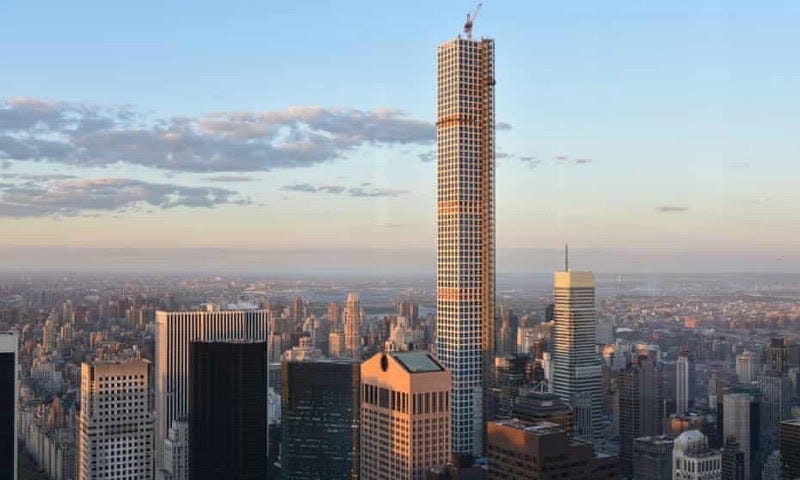
Credit: Erik Pendzich/Rex
But building up is not a complete answer. There’s a limit to how tall a skyscraper can be, and even skyscrapers cannot escape the congestion of the underlying city. If I live in a Manhattan high-rise, and you live in a different high-rise, if I want to visit you, I have to descend to the ground floor, hail an expensive taxi, and fight Manhattan traffic. We don’t escape the fundamental constraint — Manhattan is cramped.
L2 and rollups are the blockchain equivalent of skyscrapers. Each rollup is like a vertical blockchain that extends from the ground L1. There’s a lot of headroom in a rollup! But to visit one rollup from another, you have to exit to Ethereum down below and deal with its underlying traffic.
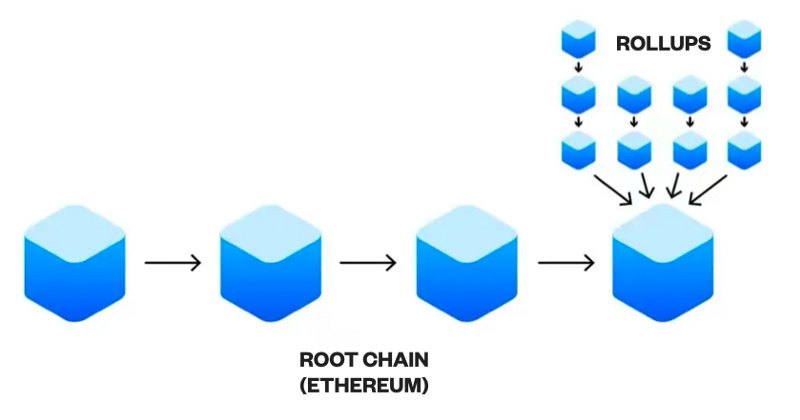
Building upward helps — it fits way more people into the city — but it’s not a complete answer. If Ethereum is crowded now, it’ll be crowded after rollups too (the billionaires can afford to stay on L1 and pay the fees).
So how else can you scale blockchains?
Path #2 is “interoperability networks” like Polkadot or Cosmos.
Polkadot and Cosmos offer SDKs for developers to launch application-specific blockchains — a small blockchain dedicated to a single application. All of these blockchains are connected by a routing system — the Relay Chain for Polkadot, the Cosmos Hub for Cosmos.
In the city metaphor, this is like creating a network of small towns that only do one thing. Here there’s a little mining town, over there a bunch of factories, then a farming town, then a town that’s just outlet stores. Each of these are connected along a massive highway system.
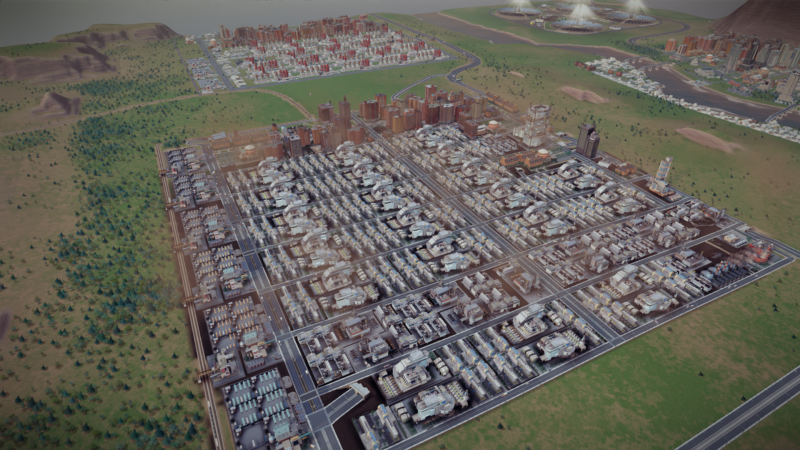
A factory town in Sim City
That works. There are some places that will be built that way. Factory towns and farming towns are a thing, but they’re not the lion’s share of where people live and do business. You’ll need more than a smattering of small towns to absorb a growing population.
That leaves #3, the last approach on how to scale a city: build another one.
This is what Solana, Avalanche, and NEAR have each done.
When you build a new city, you have to first reduplicate a lot of infrastructure. It seems redundant. Each new city requires another set of roads, another police station, a school, a hospital. In the same way, every new L1 requires another block explorer, another fiat onramp, a native AMM, an NFT marketplace. It’s redundant, but every L1 needs those basics to get off the ground.
But the nice thing about building a new city is that each city can be built differently.
Take Solana for example — Solana is LA. It’s big and sprawling and cheap compared to Manhattan. You can be a starving actor and get by in LA! Ignore that east coast fixation on decentralization — move your app to Solana, launch your NFT, and capture your 10 minutes of fame.

Sure, Solana isn’t the most decentralized. But games and NFTs don’t need that much decentralization to begin with. The weather’s great, fees are low, and no one takes themselves too seriously.
What’s Avalanche then? I’d say Avalanche is Chicago: trying to be the next Wall Street, but newer, cheaper, more aggressive. It’s cold up there, but Avalanche’s specialization in finance and trading gives the city energy and self-confidence. It’s hard not to bet on it rising.
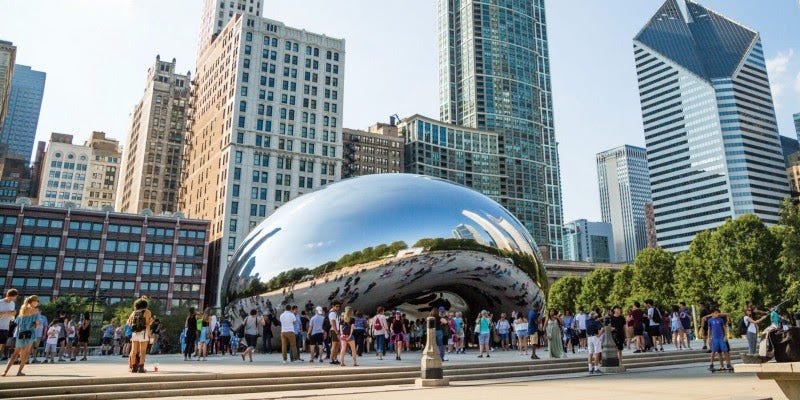
Credit: ChooseChicago
And NEAR? NEAR is San Francisco — built for web3 techies. It’s an idealistic city, full of people who want to fulfill the Ethereum 3.0 dream. In their minds, sharding is the only way forward long-term.
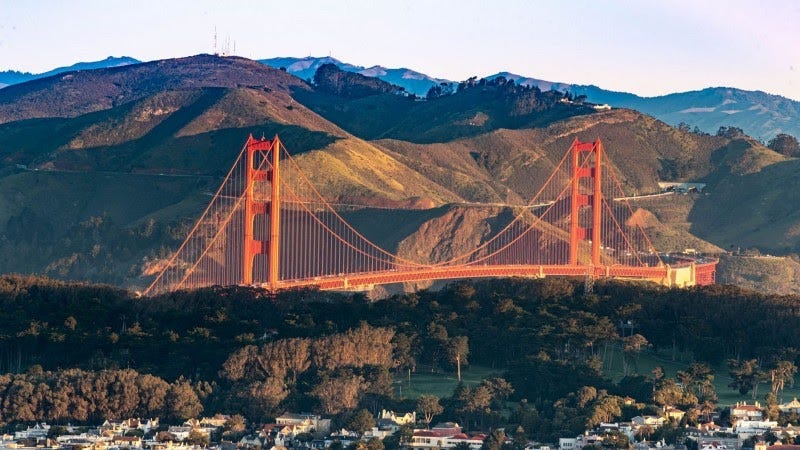
Credit: Rough Guides
The important thing about these cities is not just that they’re big and open for business. Each has a different vision of what a city should be and how it should be governed. They each accept different tradeoffs, adopt unique values, and attract different industries.
So will we live in a multi-chain world, or will there be “one chain to rule them all”?
Here’s the question reframed: will we live in a multi-city world, or will there be one city to rule them all?
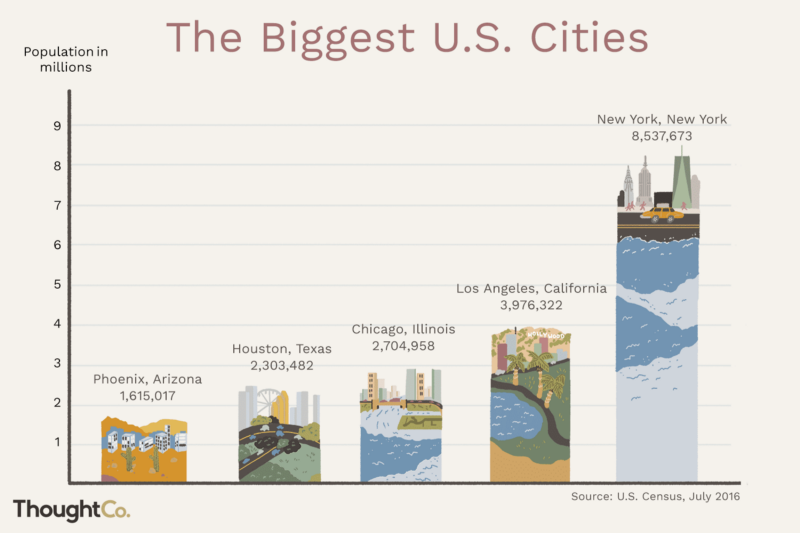
Credit: ThoughtCo
The answer is obvious. There’s a power law distribution to city dominance, but there are many cities that matter.
No metaphor is perfect. But I find this mental model useful for predicting how L1s will evolve.
I’ll leave you with six things this model predicts:
Originally published on Medium, January 2022.

The “Cypherpunk’s Manifesto” begins, “Privacy is necessary for an open society in the electronic age.” But privacy coins — cryptocurrencies with strong privacy features — have failed to take off. Monero and zcash are both worth less today than what they were worth in 2018. In comparison, ETH is worth more than twice its 2018 high. That’s just price, but the adoption metrics haven’t fared much better. Even on darknet markets, where you’d expect privacy...
read more
Of all the stablecoins I’ve analyzed, FRAX is the hardest to categorize. Most stablecoins are either overcollateralized, not collateralized at all, or their collateral level is solely dependent on the volatility of crypto. FRAX is unique; it is the most central bank-like of algorithmic stablecoins I have seen. If you take a real central bank, most of their assets are other sovereign currencies. Similarly, the assets on FRAX’s balance sheet are other...
read more